|
|
|
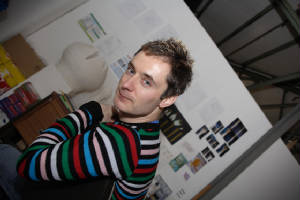
| Brendan Jamison in his studio, October 2008, photography by Tony Corey |
"Brendan Jamison is by far the most interesting sculptor to have emerged in
the last decade in the North....it's such a pleasure to welcome a real sculptor who has a deft, playful touch, as
well as an over-active imagination."
Excerpts from Brian McAvera: SCULPTURE magazine, July/August
2009, published by The International Sculpture Centre (New Jersey, America) and IRISH ARTS REVIEW, Autumn 2008
_
CLICK HERE TO VISIT BRENDAN JAMISON'S NEW WEBISTE AT WWW.BRENDANJAMISON.COM
RECENT REVIEWS


SCULPTURE magazine published by the International Sculpture Centre, New Jersey, USA
July/August 2009, Vol. 28 No. 6, pp. 70-71
REVIEWS: Belfast and Portadown, Northern Ireland: Brendan Jamison
by Brian McAvera
Queen Street Studios Gallery and Millennium Court Arts Centre
Brendan Jamison is one of a group of younger Northern Irish artists whose works are entirely unmarked
by The Troubles. His development has been rapid and engaging. He owes little to the Irish tradition of sculpture, insistently
reminding one of the British sculptors of the '80s and '90s such as Richard Deacon, Tony Cragg, Richard Wentworth, and Anish
Kapoor. Jamison's affinities with them are marked: playfulness, inventiveness, unusual use of materials, and the drive to
generate exhibitions across several continents.
In 2001, he was wrapping a tree with multi-colored threads of wool, creating an aura for it, transforming
it, and, in effect, dematerializing the object. This notion of transformation continues in his recent work, whether by wrapping,
coating in wax, or even creating objects out of sugar cubes. Jamison has stated that his practice "attempts to highlight an
in-between state or middle path, a calm place where extremes," such as "organic and architectural, male and female, Eastern
and Western...rigid and fluid, sexual and spiritual," can be seen side-by-side or in gentle convergence.
In the first of his two recent exhibitions, "In-Between", the wrapping element came to the fore.
Three large-scale installation pieces, Yellow Spiral Staircase, Red Tunnel, and Blue Bridge, all made out of wood, had been
wrapped in brightly colored wool, specially ordered from Tivoli Spinners in Cork. Yellow Spiral Staircase has a strong sense
of the playful and humorous. Lacking handrails and ascending from the floor to the ceiling, it is deprived of the normal staircase
function, or actually going somewhere. One could imagine this child-dangerous, as opposed to child-friendly, piece being resurrected
in another life in a playground for adults.
The same slightly joky, slightly surreal ambience pervades Red Tunnel, though this much more ambitious
piece taps into archetypal imagery, tribal sculpture, and darker recesses of science fiction. The construction, which echoes
womb-like caverns and can be entered, was based on the sci-fi drama Earth: Final Conflict. This description, however, makes
Red Tunnel seem more solemn than it is. Unusually, this piece wears its imagery lightly. It's interactive (small childern
are irresistibly attracted to it), and its feminine elements (the warmth and softness of the wool, the amniotic connotations
of the womb) are balanced not only by the male under-pinning of wood, but also by small boys entering the forbidden zone.
With the "JCB Bucket Series", Jamison shifts into a different gear. The idea for the exhibition was
generated when he was walking around post-conflict Belfast, currently one huge redevelopment site. JCB back-hoes are ubiquitous
in a redevelopment area, and what particularly appealed to Jamison were the animal-like qualities of the "head" or bucket
when it was "protectively" down, at ground level, at nighttime.
The works, initially based on Lego versions of JCB buckets, are made out of microcrystalline and
paraffin wax over wood. If one thinks of the sci-fi world of Alien, particularly of the bio-morphic, surreal, and menacing
elements, and then introduces a disturbingly playful sense of humor, you get JamisonWorld. With this series, the socio-political
elements of regeneration are barely registered. As in classic sci-fi, the world of the inanimate is made animate. "Exuberant"
is perhaps too strong a word, but the world of toys, of childhood, of the ogre-ish imaginings of fairy tales is re-animated
in these works.
The most successful examples are those in which the transformative element dominates. The wax, suggesting
stalagmites and stalactites, drips, for example, into fanged incisors. Baby JCBs are birthed and sheltered, kangaroo-style,
by the "mother", or the mother form develops a noticeably pregnant swelling. Rigid strata are transformed with wax, transmuted
and transposed - the ordinary becomes the extraordinary. It's such a pleasure to welcome a real sculptor who has a deft, playful
touch, as well as an over-active imagination.
Brian McAvera
____________________________________________________


AXIS ARTIST PROFILE: Brendan Jamison
By Sanna Moore
Brendan Jamison’s sculptures are a set of contradictions, masculine/feminine, fragile/solid,
organic/architectural. He takes inspiration from the New British Sculptors of the early 1980s’ like Cragg and Kapoor.
He works in a variety of organic materials such as wood, wool, wax and sugar. Each material represents
a different strand to his work which he develops concurrently, changing his focus from one material to another. Each time
he revisits a material his knowledge and understanding of its properties deepens taking his practice to another level.
His use of the sugar cube is perhaps the material which has drawn the most attention to his work.
Using the sugar cube as a building block he created a series of biomorphic sculptures for his MA show, In-Between, 2004. This
series of seven narrow towers (the tallest is almost three metres high) stood precariously as if they could topple at any
given moment. Jamison’s practice is based in architecture; In-Between was inspired by the architecture of Islamic Minarettes,
Hindu Temples and buildings within the science-fiction genre.
The laborious and time-consuming process of creating the sugar cube pieces takes months of repetitive
labour. Each cube is attached to the next with glue, an intricate and dexterous process of building. As a child, Jamison was
obsessed by constructing forms with Lego. The sugar cube gives him a similar material to work with but the control of the
construction is now dependent on his own system of securing and stabilising the structure. Although sugar cubes are the product
of a manufacturing process, each one is slightly different. The addition of the glue to secure each one to the next causes
additional imperfections to each cube when the glue dries, making each sculpture individual.
The organic forms of the sugar cube towers embody Jamison’s interest in the androgynous, his
work often blurring the boundaries between genre and sexuality. Like Cragg, his work elicits a response to organic and artificial
environments suggesting connections between these opposing worlds. Jamison’s use of the sugar cube immediately recalls
Cragg’s dice sculptures where the surface of the structure is covered with countless die, each one glued in place. Jamison
replicates this process but the sugar cube forms the sculpture as well as providing the decorative aspect.
Recent commissions have seen Jamison develop the sugar cube sculptures into stronger architectural
forms. For example Sugar Walk, 2008 (a commission to make an architectural model for a city centre apartment block planned
for 2011) ; Reichstag Sugar-Cube Dome, 2009, a solo exhibition at the John Erickson Museum of Art, Berlin, celebrating the
10th anniversary of the world renowned Norman Foster designed dome (Jamison was invited to build a sugar cube version of this
state-of-the-art glass and metal edifice). His latest work Helen’s Tower, 2009, is a replica of a Scottish-Baronial
styled tower built in 1850 in Bangor, Northern Ireland. This sculpture alludes to a magical world of fairy tales, fantasy
and childhood, other themes which run through Jamison’s practice. The structure of these latest works appears solid
and indestructible; they do not hover precariously like earlier pieces. The attention to detail and the craftsmanship of the
roof, turrets and staircase of Helen’s Tower is phenomenal, showing the artist’s growing confidence with his materials.
Sanna Moore, 21 August 2009 Exhibitions Curator, Towner Art Gallery, Eastbourne, England
____________________________________________________


SUMMER 2009
25 years of Irish art: a personal selection
Brian McAvera makes the case for a reappraisal of Irish artists who, he believes, have been undervalued
by the art establishment over the past quarter century
Brendan Jamison
This artist is only thirty. He's a sculptor who often uses unusual materials {wool,sugar} and who
clearly derives from the great generation of British sculptors who included Richard Deacon, Anish Kapoor, Tony Cragg and Richard
Wentworth. Like Deacon and Wentworth, he has a strong sense of the playful, of the innocent - and therefore potentially dangerous
- world of childhood. Upon occasion, as in the more installational nature of an earlier show at the Millennium Court, he can
plug into the concerns of Tribal Art, albeit with a feminine delicacy. As with Deacon and Kapoor, objects, in his hands, shift
from the inanimate to the animate, becoming metaphorical. In the JCB Bucket series the construction industry of Belfast {which
is still busily re-arranging the skyscape}, metamorphosed into fifteen JCB Buckets, which were of varying sizes, vibrant colours,
and wax-dripped textures. Think of the biomorphic, surreal and distinctly disturbing world of the Alien films, and then introduce
an equally disturbing and playful sense of humour. As in classic fairy tales the absurd seems perfectly normal. A JCB Bucket
gives birth to a baby JCB, wax dripping onto fanged incisors. It's too early to say how this artist will develop but he is
maturing and exploring at a rapid rate. He has none of the baggage of the 'macho' tradition of Irish sculpture and thankfully
none of the romantic whimsy. He's definitely one to watch.
Brian McAvera is an art critic. THE IRISH ARTS REVIEW, SUMMER 2009, p 58.
____________________________________________________


Monday 10 November 2008
Artist’s Sugar Cube Scale Model takes 11,000 lumps
by James Harding
Belfast: An artist from Northern Ireland has revealed a unique collection of sculptures made
entirely from sugar cubes. Brendan Jamison, 29, can take up to two months to create each model. He recently crafted a 1:100
scale model of new apartments planned for the city’s Cathedral Quarter. Sugar Walk, created for Bradkeel Developments,
contained 11,256 cubes. “I enjoyed the challenge of the Sugar Walk project, especially given that the site’s location
is only 100 metres from my studio,” he said. Mr Jamison’s largest design stands at 9ft tall and was put together
using 19,342 cubes.
__________________________________________________


Channel 5 News at 7
Monday 10 November 2008
CUBISM: This brings a whole new meaning to cubism! It is the handy work of artist
Brendan Jamison who used 11,000 sugar cubes to build this model of an apartment block set to be built in Belfast. How
sweet!
__________________________________________________


BBC BRAZIL
Tuesday 11 November 2008
Escultor faz maquete de prédio com 11 mil cubos de açúcar
by Monica Vasconcelos
Um escultor usou 11.256 cubos de açúcar para fazer uma maquete de um prédio de apartamentos que deverá
ser construído em Belfast, na Irlanda do Norte.
O artista irlandês Brendan Jamison criou a maquete do prédio de 14 andares, projetado por um
escritório de arquitetura. Ele deu uma atenção especial a detalhes como sacadas, terraços e o telhado curvo da cobertura.
O artista afirmou que seu estilo de arte "sempre foi muito influenciado pela arquitetura".
Ele disse que gostou do desafio de trabalhar na maquete especialmente porque o prédio ficará
a apenas cem metros de seu estúdio em Belfast.
"Açúcar é um material bom para se trabalhar, ele pode ser cortado e esculpido para criar formas orgânicas
e os cristais de açúcar podem resultar em uma superfície brilhante sob luz natural", afirmou. O artista estima que sua
maquete, com 60 centímetros de altura, 67 centímetros de largura e 41 centímetros de profundidade contenha 8,16 bilhões de
cristais de açúcar. Sua maquete consumiu ainda 2,25 litros de cola.
"Eu venho usando cubos de açúcar como tijolos em esculturas grandes desde minha exposição Masters
of Art, em 2004. Na época, criei uma série de sete esculturas tipo minaretes com 9 pés de altura (o equivalente a 2,74 metros)."
Segundo Jamison, foi isso o que chamou a atenção do Grupo Fitzrovia, que criou o projeto do edifício.
O nome do edifício também é uma forte indicação da conveniência de ter um escultor que trabalha com açúcar: ele se chamará
Sugar Walk.
O modelo de Brendan Jamison foi baseado em um projeto original produzido pela empresa Gregory Architects,
e a construção do prédio será concluída em 2011.
__________________________________________________

Monday 10 November 2008
Sweet....Sugar cube model, Belfast, Ireland
EDITORIAL by Michael Hammond
Building on the strong link between art and architecture, local company Bradkeel Developments
commissioned Belfast sculptor Brendan Jamison to build a sugar-cube model for the proposed ‘Sugar Walk’ development
on Great Patrick Street in Cathedral Quarter, Belfast.
Designed by Gregory Architects, this exciting new development boasts 14 floors of luxury apartments.
In March 2008 Jamison began working on the architect’s plans to produce a 1:100 scale model.
The finished piece pays close attention to detail, with the balconies, terraces and curving penthouse roof all captured to
a high degree of accuracy.
Jamison states, “my own art practice has always been heavily influenced by architecture and
inner city redevelopment. I enjoyed the challenge of this Sugar Walk project, especially given that the site’s location
is only 100 metres from my studio at Flax Art on Corporation Street. Sugar is a beautiful material to work with, it can be
cut and carved into organic shapes and the sugar crystals can provide a sparkling surface in natural light.
I have been employing cubes as building blocks in large sculptures since my Masters of Art show back
in 2004, at that time I created a series of seven 9ft tall minaret-styled sculptures. It was these works that caught the eye
of Paul Fitzsimons of Bradkeel Developments while googling for a sugar-cube artist. He couldn’t believe his luck to
find one located just around the corner from the development site! Having now completed building the model, I would love to
own one of the penthouse apartments; the views from the top floor will be stunning. Sugar Walk will offer a new sweeter perspective
on viewing the Cathedral Quarter!”
FUN FACTS: STATISTICS
Dimensions: height 60 cms, length 67 cms, width 41 cms
Number of cubes in model: 11,256
Quantity of glue in model: 2,225ml (2.25 litres)
Number of sugar crystals in each cube: 725,000
Total number of sugar crystals in model: 8,160,600,000 (8.16 Billion)
__________________________________________________


Vol. 25 no.3, Autumn 2008, p. 87
AGAINST THE CANON
"Brendan Jamison is by far the most interesting sculptor to have emerged in the last decade
in the North" Brian McAvera
__________________________________________________


Online Review: June 2008
Review by Declan McGonagle
Basement Gallery, Dundalk, May 2008
THE SPACE IN BETWEEN
Curated by Fiona Mulholland
The apparently toytown images of Brendan Jamison, where JCB buckets, of various sizes and types,
which are synonymous with the building industry and urban change, are coated in brightly coloured, dripping wax, are, at once,
a reference to a past childhood and innocence and also a depiction of nature reclaiming a man-made artefact or tool. While
recognisable as man-made, the coated buckets are on the verge of looking natural, as if perceived now, at a point frozen in
their transformation – ‘in between’. The individual pieces here act as catalysts for an enlarged reading
beyond their strong aesthetic presence.
The Space in Between, therefore, is a synopsis, an ‘object’ lesson in contemporary sculptural
concerns and practice that would stand wherever it were shown. The exhibition erases inherited categorisations across which
the artists mark out their cross referencing propositions about negotiable process and space. Working from within their own
practice and understandings of art and historical contexts, each artist has managed to speak in their own voice but also dialogue
with other voices in the show. This is, of course, a measure of the curation and the capacity of the gallery context to test
the art. In this period this process has to be an essential characteristic of publicly funded gallery/institutional provision,
as we try to create new models of practice and reciprocal relations between artist and society.
We have all eaten from the tree of knowledge and cannot go back to ‘Eden’ and this art
reflects both the complexity of a new reality and our complicity in it.
Declan McGonagle
__________________________________________________


CIRCA Summer 2008, pp 85-87
Review by Slavka Sverakova
Millennium Court Arts Centre, Portadown February-March
2008 Queen Street Studios Gallery, Belfast
February-March 2008
Brendan Jamison
IN-BETWEEN: New work and JCB BUCKET SERIES
Both concurrent exhibitions address the inertia of thinking and the stifling effect of majority-led
culture and custom on liberty. [1] Brendan Jamison [2] has preferred the liberating qualities of non-traditional materials,
including sugar cubes, wax and wool, gluing, cutting and pouring them into highly finished objects ever since his early work.
[3]
The new works share a valiant loyalty to primary colours and the desire to dislodge familiar function
by segueing into play. Built specifically for the MCAC gallery, Yellow Spiral Staircase (2008) soars upwards, touching the
sloped ceiling, as if documenting Kandinsky’s description of the physical effect of yellow as “shrill” and
“high treble notes.” [4] Its wooden skeleton, partly transformed from hard wood to soft assembly of exactly measured
lengths of wool, is decidedly an object to observe and touch and not one to climb. The ensuing relationship between the word,
ie ‘staircase’, and the visible denial of reaching another space, allows reality to become continuous with imagination.
The relationship between reality and mental acts has been long understood as constituent of ‘intentionality’.
This has been variously defined as “immanent objectivity” (Franz Bretano, 1838-1917), as “consciousness”
(Jean-Paul Sartre, 1905-1980) and as a sentient condition where an individual’s existentiality identifies with ontological
significance as opposed to what is merely ontic [5] (Martin Heidegger, 1889-1976). Sentience is ability to make conscious
choices including not doing, not talking, etc. [6] Jamison’s yellow sculpture engages us in the move from physical stance
and design stance (mass, volume, verticality of the staircase) to the intentional stance [7] that activates beliefs, thinking,
and crucially, the imagination. This process is intensified by scale, colour, material and position in space. The Apollonian
faith in the necessity of order is embodied in the thirty-three-piece assembly that withstands the pull of gravity.
As a sculpture it depends on ambivalence for a quality of antithetical referents. It approximates
the form of which it speaks but, as Hegel put it, it remains essentially a question. The wool acts like cracks in the bark
of the wood it covers, without unveiling its existence and history. The substitution of past by presence (ie the actual observer’s
look, gaze, perception) and by future (ie the observer’s imagined purpose or function) could act as a wake-up call to
a public obsessed with the past. Thus, the work enters the public domain as a question about the future.
The above is true for the horizontal Blue Bridge (2006) [8] more so than for the last of the
three objects, Red Tunnel (2007), [9] made of red loops that remind me of a pergola. Kandinsky [10] thinks of blue as invitation
to touch, to stroke an object and receive relief, in this case “a pure inner resonance” with an illusive safe
crossing. Suspension of reason allows the Dionysian principle of spontaneous impulse briefly to engulf the experience, it
being the flux between concept and material, between construct and appearance, between the word and the removal of familiar
function.
At Queen Street Studios Gallery, the JCB Bucket Series (2008) consisted of a gallery-floor display
of fifteen different industrial models made from wood, covered with microcrystalline and paraffin wax in one of the primary
or secondary colours.
Familiar function was preserved in form but denied by material. The colour chimed with Kandinsky’s
“colour is the keyboard, the eyes are the hammer and the soul is the piano.” [11] The installation became a jolly
assembly of personages [12] dancing, jumping, biting, chatting, lying on the back, being pregnant, etc. Kandinsky [13] pointed
to the power of children to clothe internal content into strong form. In reversal, Jamison took a strong form and clothed
it in imagined animation. I cite Kandinsky because he faced squarely both the ontic presupposition of a work art and what
Rubens called the “inner idea.” [14] At present ontology and epistemology are no longer kept apart due to innovations
in quantum physics. In philosophy, Daniel Dennett worked out that the intentional stance is a level of abstraction in which
we view the behaviour of a thing in terms of mental properties. A number of beliefs, thoughts and intents may be a theorist’s
fiction, but operationally they are valid, throwing light on how art evokes a contingent truth that appears as a necessary
one.
[1] Inspired by J S Mill’s (1806-1873) defence of liberty [2] See www.brendanjamison.com[3] Born in 1979, he completed an MFA in 2004. [4] Wassily Kandinsky, ‘The effect
of colour’, 1911 in H Chipp, Theories of Modern Art, 1968, pp 153ff [5] ‘Ontic’ is the physical, factual
existence; philosophy traditionally distinguishes between ontology and epistemology. [6] Eg, when I hear a tone, I cannot
be sure that there is a tone for others to hear, but I am certain that I hear it. It is an awareness of
possible truth, not truth. ’Sentire’ in Latin means to feel; sentience is well established in Buddhism: the first
vow in Bodhisattva reads: “Sentient beings are numberless, I vow to free them.” [7] The three terms were
coined by Daniel Dennet, The Intentional Stance, 1987 [8] Blue Bridge was create in 2006 and exhibited at Draiocht Arts
Centre, Blanchardstown. Red Bridge (2006) was made during a residency in October 2006 and exhibited at KHOJ, New Delhi. [9]
Red Tunnel (2006), exhibited at Draiocht Arts Centre, consisted of seven components; its bigger version made from sixteen
‘loops’ was made specifically for MCAC in 2008. [10] Kandinsky, op cit, pp 154 [11] Kandinsky, op cit, pp
154-5 [12] David Smith called his steel sculptures painted with oil paint “personages” in the early 1960s [13]
Wassily Kandinsky, ‘On the problem of form’, 1912, in H Chipp, Theories of Modern Art, 1968, p 166 [14] Peter
Paul Rubens (1577-1640), ‘De imitatione statuarum’; English translation in R Friedenthal (ed), Letters of great
artists, 1963, p 162
Reproduced with the permission of Slavka Sverakova and Circa
__________________________________________________


IRISH NEWS
SPINNING A NEW TYPE OF SCULPTURE By Jenny Lee
02/02/08
Jenny Lee chats to Belfast artist Brendan Jamison about his latest colourful woolly creations ...
Demonstrating that wool can be used for so much more than knitting woollen jumpers, Belfast artist
Brendan Jamison’s latest exhibition explores the concept of space and freedom of choice, through the use of large-scale
wool sculptures.
As an artist Brendan Jamison is constantly aware and engaging with the sensual and psychological
effects of colour and texture on the viewer - using the unusual mediums of sugar, wax and wool. This technique breaks down
many of the boundaries that can at times isolate and distance people from contemporary art.
This new body of work features three large-scale wool sculpture installations, employing primary
colours.
A yellow spiral staircase connects the floor to the ceiling; a blue wool bridge raises up and stretches
across the centre of the gallery; and a curving red wool tunnel invites the audience to venture through.
The fun and playful nature of Jamison's sculpture is often considered to awaken a child-like wonder
in the audience, evoking a return to the more innocent, curious, magical and fantasy-driven mindset of childhood.
Proud of the fact he hasn't lost his childlike imagination, Jamison explains the process he used
in making the large-scale sculptures. "I build the structures out of wood to begin with and then I cover them with hundreds
and hundreds of strands of wool, which I measure out in my studio and then tie them on. The idea is to have them obviously
standing in certain parts but then free and flowing like a waterfall onto the floor. And that idea of creating an energy or
an aura around the object so you no longer see the actual object, it's more like this idea of a spirit or an energy field.''
The title theme of In-Between is explored through the use of space. "For the conception it's the
idea of the mind and freedom where we are not lodged in one side or the other but we are in a little imaginary place where
we have freedom to go either way. It's about the in-between state of the tunnel, a bridge and a spiral staircase and the idea
of being able to choose which way you want to go,'' says Jamison who sources his wool from Tivoli Spinners in Cork.
This exhibition engages the senses, allowing the viewer to appreciate the work not only through sight,
but through touch and smell. The show emphasises MCAC's commitment to bringing new and challenging work to audiences in the
north of Ireland and is accompanied by a number of special events, including an alternative sculpture making course.
As part of their education and outreach programme, schools and community groups are invited to choose
a specific area in their school or centre such as a tree, bench or indoor facility. Then based on Jamison's techniques take
these everyday objects and turn them into vibrant works of art, using brightly coloured wool. Workshops will take place over
the duration of the exhibition and for more information please contact MCAC Education Department.
And what advice does Jamison give to those taking part in these workshops? "Just try and be as free
and creative as possible and respond to the environment you are in. Sometimes it's just about taking something quite quirky
and unusual that may be overlooked just playing with ideas and making that more interesting.''
Based in Belfast's Flax Art Studios, the artist has a busy schedule ahead with another solo exhibition
later this month at Queen Street Studios Gallery based on wax in JCB buckets. "I've to finish that project and I've a few
more exhibitions planned and then I will look ahead to a sugar exhibition for a gallery over in Eastbourne in England in 2009,''
adds Jamison, who obtained an MA in Fine Art from the University of Ulster in 2004.
- In-Between New Work by Brendan Jamison runs at Portadown's Millennium Court Arts Centre from 7
February to 19 March. There is an artists talk on Thursday 7 February from 7-8pm.
__________________________________________________


26 May 2007
New Day For Irish Resolutions: Younger Artists Brighten Darks of Past
By Joanna Shaw-Eagle
Violence and bloodshed exploded during Ireland's three-decade fight (from the late-1960s to 1998)
between Catholics and Protestants over Irish land, but they are now finding a way to peace -- as American University Museum's
"Resolutions: New Art From Northern Ireland" shows.
Museum director and exhibit curator Jack Rasmussen traveled to Belfast, north Ireland's major
city, to put together an exhibit showing that, as he says, "times have changed." There he found the "old" -- earlier dark
and threatening murals painted on the outside of Belfast's walls -- and "new" lighter art with which younger artists, who
all grew up during unsettled times, attempt to resolve the older and current political issues.
The exhibit was an ambitious task. Several of the artists -- such as Willie Doherty, Sharon Kelly
and Paul Seawright -- movingly recall older times in their art. But others, such as Sara Greavu, Carbon Design (Michael Hogg
and Philip Napier) and Brendan Jamison express what Mr. Rasmussen calls "the present resolutions."
For example, consider Mr. Doherty's creepy night photographs that demonstrate the old philosophical
battles continue.
The catalog text tells that Mr. Doherty emerged from his childhood with haunting, fearful memories.
They continue in his present work titled "Extracts From a File," shot at night in Berlin, with only a few barely lighted buildings
emerging.
Humor comes into play with Mr. Jamison's "Helicopter," an awkward, brilliant-yellow, wool sculpture.
Here, the artist takes what's usually a weapon of war and makes it a benign domestic implement.
The show could be said to show the many faces of Northern Ireland, and a fascinating group they are.
WHAT: "Resolutions: New Art From Northern Ireland" WHERE: American University Museum at
the Katzen, Ward Circle at the corner of Massachusetts and Nebraska avenues Northwest WHEN: 11 a.m. to 4 p.m. Tuesdays
through Sundays, closed Mondays, through July 29, 2007 TICKETS: Free
__________________________________________________


THE IRISH NEWS
Visual Art Saturday 20 August 2005
Making Art Fun and Games
ARTOPOLY: Jenny Lee pays a visit to the Old Museum Arts Centre where a Belfast artist merges the
world of art and games
If you are an adult looking for an excuse to revert to a childhood of fun and games, your chance
comes in the unlikely venue of an art exhibition.
In his latest work, Belfast artist Brendan Jamison explores the politics of the art world from a
local and global viewpoint. You can play pieces such as Artopoly, a large-scale game featuring Belfast galleries and studio
groups based on the old favourite Monopoly. There is also Guess the Artist, take The Word Art language
quiz and Guess the Biennale.
Jamison’s work is characterised by a very intense use of colour, with his installations imbuing
an immediate sense of fun and playfulness. He strives to engage the viewer on a level of simple child-like appreciation of
colour. Like an artist playing the art scene, the audiences must embrace both the elements of control and chance.
Beneath the light-hearted surface, the interaction with each work can prompt deeper questions on
issues of stratagem, hierarchy, power plays and ambition within the contemporary art world. Visitors to the gallery are invited
to participate in all the artworks on display.
Pride of place is given to the Artopoly board. Replacing old favourites such as Old Kent Road, Bow
Street and Piccadilly is the likes of Belfast Exposed, Catalyst Arts, Engine Room Gallery and Belfast Print Workshop in his
who’s who of the Belfast arts scene. Designated the prestigious blue squares of Mayfair and Park Lane in the traditional
board are Ormeau Baths Gallery and the Golden Thread Gallery. Jamison pays great attention to detail and replacing train stations
are studio spaces such as Flax Art Studios and Queen Street Studios.
As the pass Go mark, players collect £200 from the Arts Council. The counters are art implements
such as a tube of paint, spatula, roller and tape. Houses and hotels are replaced by paintings and sculptures. Chance and
community chest cards say things like: Collect £325 for leading life drawing classes at the Crescent Arts Centre or The Arts
Council has rejected your proposal. Jamison replaces the traditional go to jail scenario with ‘go to art college’.
The guess the artist game is a variation of the popular Guess Who game, where the usual names and
faces of characters like Claire and Alfred have been replaced by artists. The game sits on table tops in the café area, so
visitors can enjoy a game over a coffee and chat.
__________________________________________________

BELFAST TELEGRAPH
Monday 22 August 2005
Art proves ideal for the Board ARTOPOLY: Brendan Jamison, Old Museum Arts Centre, Belfast
Review by Ian Hill (Man About Town)
Artopoly’s centre piece is a vast replica board-game where Belfast’s art galleries replace
the hotels of Mayfair and houses of the Old Kent Road. So Hugh Mulholland’s Ormeau Bath’s Gallery would cost you
£400 of Brendan’s mock Arts Council grant money, while Bernard Jaffa’s ArtTank is yours for just £150.
Continuing his satire on art’s bureaucracy, Brendan supplies giant Community Chest and Chance
cards. One suggests setting fire to a gallery as an art installation. Another promises to be featured in Man About Town.
Royce Harper, presenter of Northern Visions TV’s The Artery slot, had come to launch the exhibition.
But first he filled in his voting form for President of the Art World.
Peter Richards, the shows curator persuaded his partner to play another wall game. In it you are
asked to identify international art fairs solely from maps of countries that hold these biennials.
Brendan’s provocative and amusing show has its serious side. It examines the possibly unjustified
role of ambition and governance in the contemporary art world. There are artists who are great and there are artists who are
great at filling out Arts Council grant application forms. And they aren’t necessarily the same people. __________________________________________________
REVIEWS ARCHIVE
2009
McAVERA, BRIAN. "Reviews: Belfast and Portadown, Northern Ireland: Brendan Jamison", SCULPTURE,
International Sculpture Centre, New Jersey, July/August 2009, Vol. 28 No. 6, pp. 70-71
MOORE, SANNA. "Artist Profile: Brendan Jamison", AXIS online, London, 21
August 2009
McDONOUGH, ROISIN. ACNI Annual Review
08:09, Arts Council of Northern Ireland, April 2009, p. 1
McAVERA, BRIAN.
"25 Years of Irish Art: a personal selection: Brendan Jamison", Irish Arts Review 25th Anniversary
Edition, Summer 2009, Vol 26 no. 2, p. 58
2008
GIBB, BILL. “Why this sculptor’s not so keen on having tea breaks”, The
Weekly News, Glasgow, 27 December 2008, p. 13
MOULTON, EMILY. “One Lump or a Thousand?”,
Belfast Telegraph, am edition, Tuesday 11 November 2008, p. 3
VASCONCELOS, MONICA. “Escultor faz maquete
de prédio com 11 mil cubos de açúcar” BBC BRAZIL, 11 Nov 2008
HARDING, JAMES. “Artist’s Sugar
Cube Scale Model takes 11,000 lumps”, The Times, Monday 10 November 2008, p. 18
GROGAN, MILLISA. “Sugar Walk by Brendan
Jamison”, Channel 5 News, London, 7 O’Clock broadcast, 10 Nov 2008
HAMMOND, MICHAEL. “Sweet…sugar
cube model, Belfast, Ireland”, World Architecture News, London, 10 November 2008
McAVERA, BRIAN. “Against the Canon”,
Irish Arts Review, Dublin, Vol. 25 no.3, Autumn 2008, p. 87
McGONAGLE, DECLAN. “The Space In-Between: curated by Fiona Mulholland", CIRCA online,
Dublin, June 2008
SVERAKOVA, SLAVKA.
'Brendan Jamison: In-Between & JCB Bucket Series' - CIRCA 124, Dublin, Summer 2008, pp.
85-87
NICOL, GILLIAN. “Irish Uplift”,
a-n Magazine, Newcastle, England, May 2008, p. 20
RUSSELL, CHRISSIE. “Brendan Jamison’s
JCB Bucket Series”, Belfast Telegraph, am edition, 29 February 2008, p. 18
LEE, JENNY. “Spinning a New Type of Sculpture”, The Irish News, Belfast,
2 February 2008, p. 3
McDONOUGH, ROISIN. Arts Council
of Northern Ireland Annual Review 07:08, front cover and p. 11
2007
SHAW-EAGLE, JOANNA. "New Day For Irish Resolutions", The Washington Times, Washington DC, 26 May 2007
RASMUSSEN, JACK. Resolutions: New Art From Northern Ireland, Washington D.C.,
American University, pp. 16-17
HUTCHINSON, PAUL. “Short Film Profile:
Brendan Jamison”, Culture Northern Ireland, Belfast , Summer 2007
FITZGERALD, PETER. “Vox Pop”, CIRCA,
Dublin, Spring 2007, Vol. 119, p. 30
OSKAY, WINDELL. “3D SUGAR SCULPTURE PRINTER
PROJECT”, Evil Mad Scientist Laboratories, online, 24 February
2007
2006
“Delhi Review: Arts and Crafts: Discovering Roots”, The Hindu, New Delhi,
Friday 17 November 2006
GRAHAM, RUTH. Plan X,
Belfast, Golden Thread Gallery, pp. 26-31
2005
WELCH. ROBERT. Masters Twenty Five Years On, Belfast, Ormeau Baths Gallery, 2005, pp. 64, 185
& 201
HILL, IAN. “Royal
Ulster Academy of Arts”, Belfast Telegraph, city edition, Thursday 22 September 2005, p. 15
BRANIFF, JOANNA. “Autumn Treats
in Store for Arts Lovers”, The Irish News, Belfast, Saturday 22 August 2005, p. 39
MUIR, MARIE-LOUSIE. “Artopoly at OMAC" Arts Extra, BBC Radio Ulster,
Belfast, Tuesday 30th August 2005, 6:30 pm
HILL, IAN. “Art Proves Ideal for the
Board”, Belfast Telegraph, city edition, Monday 22 August 2005, p. 8
LEE, JENNY. “Making Art Fun and Games”,
The Irish News, Belfast, 20 August 2005, p.42
SHEPARD, DARCY. “Around the World in
less than 10 minutes” The Orion, Chico, California State University Chico, 11 May 05
GRAHAM, RUTH. Flaxart Studios, Belfast, Flaxart,
2005, pp. 16 - 17
2004
DONNELLY, CIAN. “See”, CIRCA, Dublin, Summer 2004, p. 26
CAMPBELL, BRIAN. “Masters of Art”,The Irish News,
Belfast, 22 May 2004, p. 49
SVERAKOVA, SLAVKA. "Open Ended"- MFA
04, Belfast, University of Ulster, 2004, pp. 24-27
|